Have you ever walked into a home and known, before anyone said a word, exactly what kind of home it was going to be? Very often, that first impression comes from overhead. A foyer chandelier is the first light guests see and the last one they pass on the way out, and in a grand entry it sets the tone for every room that follows.
It is also one of the easiest pieces to get wrong. A fixture that looked substantial in a showroom can read like a small pendant once it's hanging in a two-story entry, while one that's too large crowds the door and the staircase.
In this guide, I’ll walk you through the simple formulas designers use to size, hang, and style an entry chandelier, along with pieces from our collection that suit different spaces and architecture.
Use the Room to Find the Right Width
The most reliable starting point is a simple formula: add the length and width of the foyer in feet, and use that number in inches as the chandelier's diameter. A 14-by-16-foot foyer, for example, calls for a fixture about 30 inches across.
In a grand entry, it's usually better to go slightly larger than the formula suggests than slightly smaller. Double-height spaces make light fixtures look smaller than they are, and a piece that feels generous at eye level often looks just right from the floor below. Check it against the front door, too. As a general guide, the chandelier shouldn't be wider than the door it greets.
Scale the Height to the Ceiling
For the fixture's height, allow about 2.5 to 3 inches for every foot of ceiling height. A 20-foot ceiling suits a chandelier roughly 50 to 60 inches tall, or a tiered design that reads as one composition.
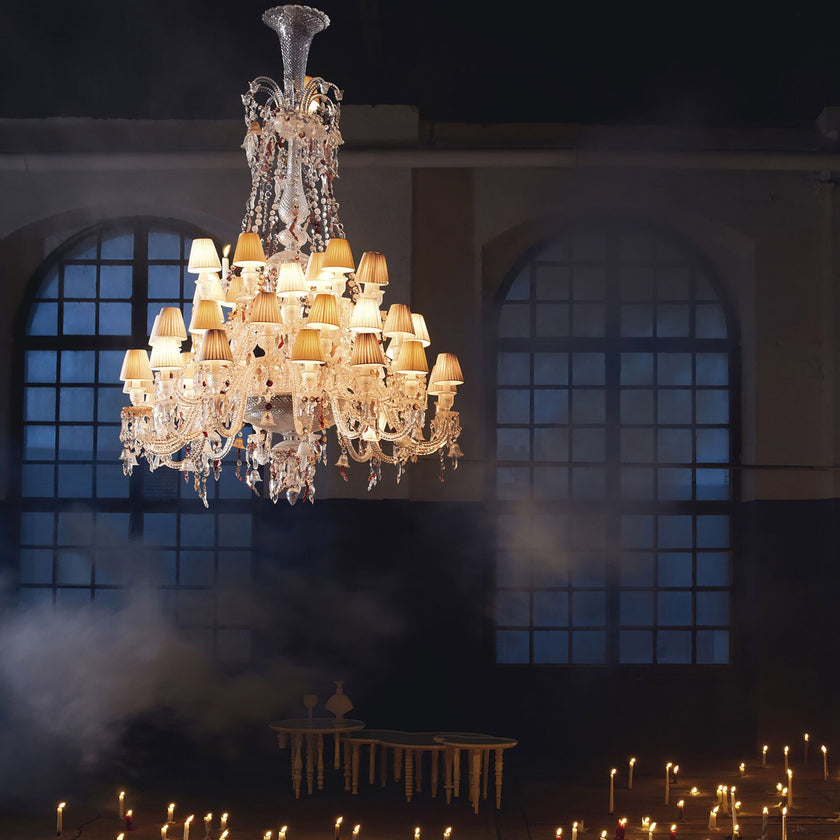
Tiered and vertical forms are made for this. The Lalique Champs-Élysées 3 Tiers Chandelier layers three tiers of finely veined crystal leaves, inspired by the Champs-Élysées bowl Marc Lalique designed in 1951, giving it the presence to fill a tall foyer while still feeling light. For the most dramatic spaces, the Lladró Niagara Chandelier cascades handmade porcelain fairies down two meters of fiber optic strands, each one glowing with subtle points of light, a piece made for double-height ceilings and grand staircases.
Hang It at the Right Height
In a single-story entry, the bottom of the chandelier should hang at least 7 feet above the floor, so it clears even the tallest guests and the swing of the door.
In a two-story foyer, the goal changes. Center the chandelier in the space and hang it roughly level with the second floor, or centered in an upper window if there is one above the door, so it can be enjoyed from the entry and from the landing above. Either way, keep at least 7 feet of clearance beneath it.
If the chandelier hangs near a staircase, view it from the stairs as well. You want it visible from every landing, but never close enough for someone to reach out and touch it.
Match the Style to the Architecture
The architecture of the entry should guide the silhouette. Traditional homes with detailed millwork and a sweeping staircase suit classic forms such as crystal, candle-style lights, or a lantern. The Maitland Smith Maison Lantern frames candle-style lights within a structured metal frame crowned with leaf detailing, a form well suited to entryways and stair halls.
Contemporary entries call for sculptural shapes and fewer, bolder materials. The Fine Art Handcrafted Lighting Vol de Cristal Chandelier sets graceful sweeps of tapered, beveled crystals into metal wings finished in platinized silver leaf, an airy form that seems to take flight above the entry. For an architectural statement, the Baccarat Tuile de Cristal Chandelier arranges crystal tiles on a white metal canvas that catches and diffracts light from every angle.
Layer the Light
A chandelier sets the mood, but it rarely lights an entry on its own. Put it on a dimmer so it can glow softly in the evening and brighten when guests arrive. Pair it with wall sconces along the stairs or flanking a console and a table lamp on the console itself, so the space feels welcoming at every hour.
Choose warm white bulbs, around 2700K, which flatter crystal, brass, and gold leaf alike.
Final Thoughts
A well-chosen chandelier makes an entry feel finished the moment the door opens. Size it to the room, scale it to the ceiling, hang it where it can be admired from every level, and choose a style that suits the architecture of your home. Explore our chandeliers, or let our e-design service help you find the right piece for your foyer.
Frequently asked questions
What size chandelier do I need for my foyer?
Add the foyer's length and width in feet; that number in inches is a good diameter. For height, allow 2.5 to 3 inches per foot of ceiling height.
How high should a chandelier hang in a two-story foyer?
Center it in the space and hang it roughly level with the second floor or an upper window, keeping at least 7 feet of clearance above the floor.
Can a foyer chandelier be too big?
Yes. As a guide, it shouldn't be wider than the front door, and it should leave clear space around the stairs and landings. In tall spaces, though, slightly larger usually looks better than slightly smaller.


